
DVDOME | home

DVD Reviews
Saving Private Ryan
The release of "Saving Private Ryan" generated a massive hype due to Steven Spielberg having also directed that other Second World War opus, "Schindler's List". Now that Hollywood has moved on and the fuss has subsided, it's clear that an important movie remains.
Much has been written and gasped about the opening 20 minutes as the GIs land on the beaches, only to be mown down by the Germans. Some recoiled at the graphic violence, others praised the realism, while some questioned whether war is really like that at all. The percentage of an audience who can accurately comment is surely small.
What is abundantly clear is that in the massive body of films that deal with World War II, this is one that pulls no punches. It consistently explores the unpredictable and random violence that engulfs and blinds the men within it.
The plot serves only to drag a squad of characters through uncharted peril with few fitting the normal pre-determined 'hero' tag of war films. They're off on a PR mission to find a Private James Ryan and take him home to his mother, who is shortly to learn that her other three sons are dead.
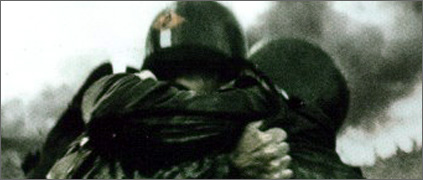
While the men are constantly under threat from the Germans, they are not engaged in a key battle that will help win the war. Without a major event to eclipse proceedings, a greater examination of each man's personal fears is allowed to shine through.
This is not a film that will please everyone and quite rightly so. But no movie about any war can seek to provide answers to every question. What Spielberg does is create a world of frightening carnage in which a small story is played out. As such, this is an important film that deconstructs war machines into separate, frightened men as it so likely was.
----------------------------------------------------------------------------------------------------------------------------------------
Sleepy Hollow
Leave it to Tim Burton to take a literary institution – the early American novella The Legend of Sleepy Hollow – and turn it into a wickedly entertaining combination of homage and spoof. Though much darker and somewhat less successful, Burton's film is reminiscent of Rob Reiner's near-perfect Princess Bride, which lovingly mocks swashbuckling romances. In Sleepy Hollow, Burton's admiration and taunts turn toward the gothic genre, one that has informed many of his best works (Edward Scissorhands, A Nightmare Before Christmas).
Burton retools the well-known tale in order to tackle some of his favourite themes. Instead of a bumbling country schoolteacher, Ichabod Crane (Johnny Depp) is a scientifically minded but squeamish New York police constable sent by his scornful superiors to solve a series of mysterious decapitations in the titular farming community to the north. Locals blame the deaths on the legendary Headless Horseman, an evil (and long-dead) German mercenary hired by the English forces to do battle with the rebellious American colonists during the Revolutionary War. Burton has taken Malcolm's admonition ("there's daggers in men's smiles") from Shakespeare's Macbeth literally in his recreation of the famous villain. Even Ichabod gets into the Macbeth mode, with a "blood will have blood" type of proclamation ("murder begets murder" he mumbles). Predictably, Christopher Walken's ghoulish visage is effectively disturbing in the antagonist's role. Crane scoffs at these legends, and is determined to deploy the latest advances in the forensic sciences to solve this case.

Johnny Depp's Crane has a pasty complexion and nervous demeanour, yet is steely in his devotion to finding a scientific explanation. His nemesis and love interest is Katrina Van Tassel (Christina Ricci) the daughter of Sleepy Hollow's wealthiest citizen, Balthus Van Tassel. Hers is a more pagan faith in some good old-fashioned white magic, which sets the stage for a showdown between reason and faith. Burton blatantly beats us over the head with references to the shackles that reason places on us ("I am pinioned by a chain of reason," cries Ichabod) while exalting the liberating qualities of Katrina's (and his own mother's) more naturalistic faiths. Fortunately, he generally plays this conflict for fun, as when Ichabod meets a sorceress and stutters in homonymic humour "I make no assumptions about your ways which, which, which…"
The film’s great sense of humour, despite (and sometimes because of) the oceans of blood spilt in the gorier scenes (there are many), is built around Depp's excellent performance. His quivering nausea, pathetic attempts to ride a horse and constant craven cowardice combine to create a classic portrait of a bumbling hero.
Sometimes mundane, often murky, and occasionally brought to a screeching halt so characters can deliver plot exposition camouflaged as dialogue, Sleepy Hollow's storyline is this film's weakest element. Fortunately, the movie more than adequately compensates for this with a droll and witty script, a constant stream of visual and aural delights (Danny Elfman's score strikes the perfect balance between serious and silly), and another terrific, self-parodying performance by Johnny Depp.
----------------------------------------------------------------------------------------------------------------------------------------
Lost in Space
Lost is right. Lost in mediocrity by worrying more about special effects than a compelling story. Lost without appropriate talent, by casting recognizable faces rather than actors suited to the parts. Lost in confusion by placing the Robinsons in the future where they meet up with themselves.
Lost in Space is another of those big money 'concept' films. The idea is just to take a 1960s television program and bring it to the big screen. After all, everyone's familiar with the title, regardless of whether they ever saw the program. Nor does it matter whether or not it was a good show. It's just the name recognition they're after.
This is what brings us William Hurt as space dad John Robinson, Matt LeBlanc (television's Friends) as a macho pilot, Lacey Chabert (television's Party of Five) and Heather Graham (Boogie Nights) as Robinson's daughters. None of these folks really seem to fit with their roles, but we know them, so they got the parts.
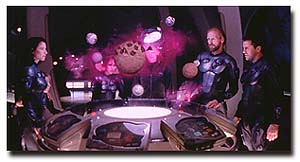
The story is pretty standard space movie fare: space ship is tossed off course by an evil enemy (Gary Oldman) who also happens to get stuck on board. The family then faces the task of surviving in outer space against all odds. There's no shortage of special effects, a few in jokes and a sub-plot about the dad's neglectfulness of his family that really doesn't go anywhere.
Lost in Space really isn't a bad movie. It just lacks inspiration. Clearly people got keen about the idea of making it, but forgot to get a script that really works.
The television remake formula resulted in not-so classic films such as The Flintstones and McHale's Navy and many more. Let's hope this is the end of the trend. Otherwise we'll be looking forward to something much worse, like Green Acres.
----------------------------------------------------------------------------------------------------------------------------------------
The English Patient
Every story looks different when you look more closely – a common thief becomes an abuse survivor; a grumpy co-worker becomes a cancer patient’s spouse; a spy becomes a desperate lover. In The English Patient, we’re presented with a man whose disfiguring physical scars prevent us from leaping to premature conclusions about him. Through present-day (1945) conversation and layers of flashbacks to more than a half-decade earlier, we gradually learn who this man is. By the time we have the information we need to pass judgement, it’s nearly impossible to reach a simple conclusion.
The English Patient is a complex story about love, loss, and searching for simplicity and beauty amidst horror and pain. It’s a Second World War drama set in Italy and North Africa that really could be set anywhere and any time, because it’s about the human heart and the pain that results when events prevent its fulfillment.
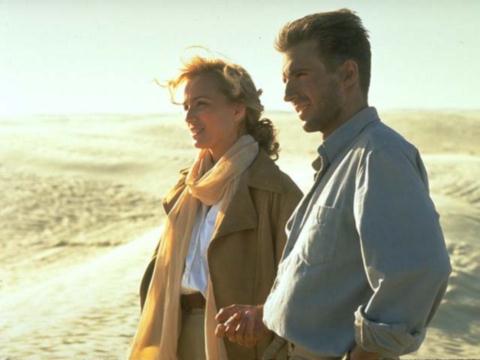
We can barely see the eyes of the ‘English patient’ ( Ralph Fiennes) as he lies horribly burned and waiting for death – but we can tell that he’s in great emotional, as well as physical, pain. His caregiver, the Canadian nurse Hana ( Juliette Binoche), also hurts unimaginably, as everyone she has loved is now dead. Taking her sole patient to an abandoned Italian villa during the last days of the war, Hana tends to him and gradually learns his story about the tragic romance that led eventually to his awful plane crash. The arrival of another Canadian at the villa – the thief David Caravaggio ( Willem Dafoe), who bears a grudge for the mysterious burn victim – forces us to consider the darkest-possible interpretation of past events. Hana’s story, and that of Kip ( Naveen Andrews) – a Sikh bomb disposal expert who is also staying on the villa’s grounds – unfold on the periphery as the English patient’s grand tale takes centre stage.
It’s a story of exploration in the Sahara, but more than that, it’s a tale of forbidden romance and the disastrous intercession of wartime complications. We learn that the English patient isn’t English at all, but the Hungarian Count Almásy. And we learn that the object of his love is Katharine ( Kristin Scott Thomas), the English wife of his mapmaking party’s benefactor, Geoffrey Clifton ( Peter Firth). As flashbacks to late 1930s North Africa unfold amidst the events of 1945 Italy, a powerful tale of love, loss and heartbreak gradually comes clear.
This ambitious film version of the wonderful Michael Ondaatje novel is a fabulous success, even though it necessarily strips down the sweeping and complex story to accommodate it within a still dense 162 minutes. Blessed with beautiful cinematography, sensitive acting (especially by Fiennes, Binoche and Scott Thomas) and a finely-crafted script, The English Patient is one of those films that sends you away awash in emotion and reconnected with cinema, reminded of how powerfully and beautifully movies can lift us and take us to fantastic places and events, while also touching us in deeply personal ways.
----------------------------------------------------------------------------------------------------------------------------------------
Gladiator
In many films that I've seen before, I've seen the classic old story about a guy taking revenge against another because the other did him a grave wrongdoing. I've also seen the story of a man seeking justice against another person who's corrupt. I've also seen some flicks that combine both, but not like this one. Gladiator slashes and soars into greatness thanks to the creative artwork, great performances, and the mesmerizing direction of Ridley Scott (Alien, Blade Runner, Thelma and Louise). Gladiator delivered last year, and I believe it deserves all the praises it got, not because its violent and entertaining, but it blends well the elements of justice and vengeance, into a solid force that drives the film all the way to the end.
Two-Time Oscar nominee Russell Crowe (The Insider, L.A. Confidential) stars as General Maximus, a tough, but worn-out soldier stationed with his army in Germania, and has only one wish: Win this fight and go home, to his family. Overseeing the battle is the ailing Emperor Marcus Aurelius (Richard Harris, another two-time Oscar nominee), who is also tired of war, and also tired of another war, the one with corruption. The fight scenes give a close resemblance to the ones seen in Braveheart, and will echo all through the movie as we go on. The battle is won, Maximus sighs and yells Roma Victor, and Marcus Aurelius asks him, how can he reward him. Maximus says he wants to go home, though that was not to be in the mind of Marcus Aurelius, and certainly not to fate.
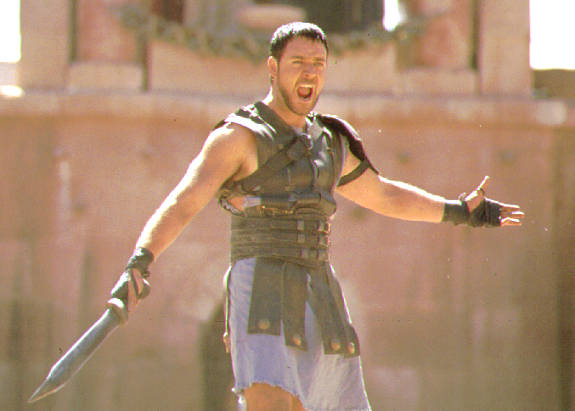
Marcus Aurelius' sons Commodus (Joaquin Phoenix in a great performance) and Lucilla (Connie Nielsen) arrive at the front, sent by the emperor, so they can decide what it is to be Rome's future. Marcus Aurelius sends for Maximus and through the talks of politics and the background of each other’s, The Emperor asks Maximus to succeed him as the new emperor. Maximus is shocked by this and tells him that he'll think about it. Later the Emperor sends for Commodus, and he tells him he won't be emperor. Why? Like Marcus Aurelius told Maximus, he is corrupt and will just bring more trash to Rome. But the twist comes, and with a broken heart, and for ambition, Commodus kills his father.
Maximus is awakened and is taken to the Royal tent, where he sees the Emperor dead. But Commodus raise his hand and says, take my hand I’m your new emperor. This mistake tells Maximus that he killed him, but as he's strapping his armor to alert the senators he is arrested, and taken to execution. But he escapes, and rides towards his house only to find it all destroyed and his family burned, and crucified.
He buries them, and falls unconscious of his surroundings due to his pain. In that time he's picked up by slave traders who sell him to a gladiator owner, Proximo (the late Oliver Reed), and through this he becomes a gladiator. Back in Rome, the new Emperor Commodus is faced with the tasks of meeting with the senate, whose head is Gracchus (Derek Jacobi), and to try to drive Rome as he sees fit. How does he do that? He organizes games in the Coliseum in honor to his father, and Proximo's gladiators go there. And in the Coliseum, will be the final showdown between Maximus and Commodus.
In the opening scenes there is an interesting touch in the production design, as we see the sun glaze upon the wheat fields, and Maximus scraping his hands across the fields, then the light broods into a dark and moody scene, where the battlefield is, and Maximus watching a bird fly away. This is very interesting because it shows you how peaceful the world can be at first, with nothing to fear, the light shinning at us all, then turns into darkness, a dreary world where killing, hatred, and corruption rule. The bird flying away represents a symbol of the light, reflecting on the horizon of the tunnel of darkness, and in a way it also tells us that us humans are like the people that are inside the tunnel, running towards the light. There are many flashback shots through the film similar to these, which depict the question "what would've happened if?" Which I think is another cool touch, and soon on the end to the wife and kid, who is running to see his dad, which is the peace finally achieved. The last one adheres with the part of vengeance in the film, but Maximus challenges Commodus also for Marcus Aurelius, whom Maximus loved. So this film depicts justice as a two-blade sword, one to bring Commodus' corruptive ways down and to take revenge over his family. Now that’s interesting, because the film shows revenge and justice together, all for a cause, when they are nearly two separate things. Other films try this blend, but in the end, you'll see that the movie was either portraying more than the other. But not Gladiator, vengeance and justice are blend well, and live up towards the end. Maximus fights in the end not only for the slain of his family but for the slain of his emperor, and wins for both in the end. Now that’s the key to the script, which was written by David Franzoni (Amistad), and thanks to that key, the movie is entertaining.
A few flaws were shown, mostly in the special effects, due to the fact that the aerial shots of Rome and its Coliseum look more like the images you would see on a video game. And when Maximus is fighting this other gladiator on some parts the tigers don't seem real. But the rest of the film, thanks to the editing, moves along in a smooth way. Director Ridley Scott has guts to do a gritty film like this one, and does a very good job depicting the fighting scenes and also in the dramatic parts, though the editing must have been a pain in the ass, though, since all the graphic violence my have gotten this film an NC-17 rating. But the editors did a great job in balancing the violence and the key drama moments of the movie.
Throughout the film, as mentioned before, there are many ferocious fight scenes that as many other people have pointed out, that is a rip-off to Braveheart. Others say that is just an extended exercise over another film Spartacus. It is not, and you have to be a total idiot to think like that. What this film gives is a hat tip towards the other two films, which means it pays respects or tribute to other great films. In this case Braveheart and Spartacus. I mean it would be a fucking rip-off if the stories and formula that Braveheart and Spartacus depict were shown untouched and equal in Gladiator. Of course this is not. And it would be stupid too because the movie would be one-sided and unoriginal. What Gladiator does, is tip his hat with the fight scenes but takes the formula of the two previous movies into a different level, it becomes and entirely different movie, and it has to be that way because if it wasn't, again, the film would suffer due to lack of originality. And that is the last thing the filmmakers would like to do.
In the end this movie is certainly one of the best films that shined more during the usual shitty summer season, and a heavy contender at the Academy, the Golden Globes and BAFTA. And I think it deserves it, because its a well made movie, of course with a few flaws, but with great performances and strong directing. in the end this film will endure the tests of time and join the other classics as a classic of its own right. If not, well then he who's about to die salute you!!!
----------------------------------------------------------------------------------------------------------------------------------------
Mission Impossible 2
As a general rule, sequels are usually not better than the originals. Sure, there are exceptions, albeit rare ones. Godfather II and Aliens are among the few. Now, there is another film to add to this all too brief list, Mission Impossible 2. Where the first film was muddled, confused and undirected, trying to be too many genres, this film makes no pretenses about what it is, an action/adventure film. For a film to succeed in this genre a few rules must be obeyed. First, the plot should be simple and straightforward. The action must come at regular intervals and the heroes should be a bit bigger than life. MI2 manages this rather well. Ethan Hunt (Tom Cruise) is the field commander of the IMF, the Impossible Missions Force. He must re-capture a deadly German manufactured virus before it can he used be the nefarious villain Sean Ambrose (Dougray Scott). Problem is, Ambrose is a former member of the IMF and like Hunt he can disguise himself as almost anyone, including Hunt. In order to retrieve the virus Hunt recruits Ambrose’s old flame, a beautiful thief Nyan Nordoff-Hall (Thandie Newton). In addition the team sports master computer hacker Luther Stickel (Ving Rhames) to help with the intricate plot to obtain the dreaded virus. (Sorry, this type of movie cries out for a melodramatic recap) The action is almost non-stop, the special effects dramatic and the acting, well, you don’t go to a movie like this for the acting.
Speaking of the acting, the actors were well chosen for their roles and they come up to the standards demanded by this genre. Cruise returning as Hunt plays it likes a younger brother to James Bond. Cocky, grandiose and a definite lady’s man he moves through this role with ease. Although he is capable of better acting he handles the role of action hero with flair. Female lead Newton is simply beautiful. She is little more than window dressing in most of the film but she does have her moments in scenes where she challenges Cruise’s character. She portrays a strong, assertive young woman that is charming and an excellent thief. She has come a long way since her last role as a sanguine Cajun dinner for Cruise in Interview with a Vampire. Ving Rhames gets the wonderful job of providing much of the comic relief needed by any action film. He is a commanding presence on the screen. One odd bit of casting is Sir Anthony Hopkins as the commander of the IMF. It seems that he had a few spare days and did this film on a lark. His character does little more than add a face to the famous voice on the tape that will self-destruct in five seconds.
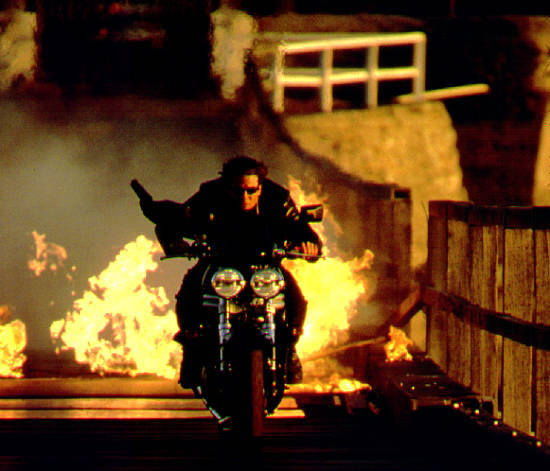
This film is fortunate to have one of the best action directors ever, John Woo. Coming to Hollywood from the Hong Kong martial arts studios he brings the best of these ‘Gung Fu’ films to the screen. His trademark twin .45s blazing as the actor flies across the is there as well as the largest number of gunshots possible in any film. There are more gunshots in one scene of this film than in the entire two and a half-hours of Saving Private Ryan! What sets Woo apart from other action directors is his ability to concentrate on the smallest detail of the scene. Each shot of the film is framed to perfection, lit perfectly and choreographed with precision. He merges CGI effects with live action better than most action directors, letting the computer and live action work together rather than seeming to compete.
The disc itself is excellent! The Dolby 5.1 audio will give all six of your speakers a workout. The sound track booms from all sides, the special effects surround you and draw you in. Because of a lack of handicap accessible theaters, this is one of the few films I got to see in the theater and the DVD comes across as far better. The anamorphic 2.35:1 video is calibration quality and holds together under all lighting conditions. The extras provided are far better than the usually fair. Besides the typical making of and special effects shorts there is a little parody of MI2 from MTV’s movie awards with Cruise, Woo and Ben Stiller as Cruise’s much abused stun man. This is a must have disc for any collector.
----------------------------------------------------------------------------------------------------------------------------------------
The Rocketeer
It's better than you think.
A lot of people give this film no props. Why? The acting is admittedly a bit stale, but when you think of how bad the acting was in some of those old-time serials (which is the feel this film is aiming for) it's acceptable. Besides, mmmm...that Jennifer Connelly.
Anyway, this film follows the somewhat brief adventures of the Rocketeer. Everything is pretty much straightforward, there is no symbolism or "message" to this film, but the action is both exciting and kinda humorous at the same time.
The mise-en-scene (you never took a film course?) makes the viewer nostalgic for the old days. The direction and script scream "Disney!" but the story is perhaps one of the most plausibly natural progressions of an ordinary man-turned-super hero.
A lot of critics panned this film, mainly because critics have no soul and probably were never young. I encourage you to see this film because it is a landmark in film-making. It was released after the hype and hoopla of Batman 1, and ever since that point, superhero flicks have gone downhill (animated films aside, that is).
You won't enjoy this film if you have a callous heart, hardened by life and passers-by spitting upon you.
----------------------------------------------------------------------------------------------------------------------------------------
Blade Runner
What do you say about a movie you can't fully understand, even after seeing it more times than you've actually spoken to your own parents?
What can one possibly add about film that has been so meticulously deconstructed, so tediously documented, so thoroughly analyzed that the mere thought of trying to create even a scintilla of new insight is both futile and ridiculous.
Nothing. But when it comes to Blade Runner, I'll try anyway.
In my mind, the greatest sci-fi film of all time succeeds on many levels, not the least of which is subtlety. A complex plot lovingly portrayed through thoughtful (if sparse) dialogue and a heaping helping of subtlety, is framed by special effects that still, more than a decade later, remain special.
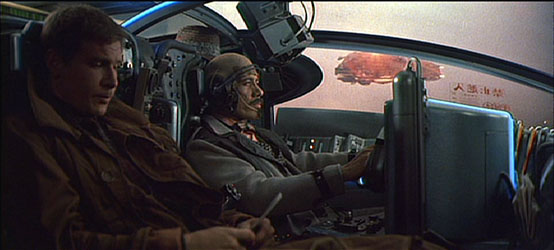
Like any work of entertainment (or dare I say it? art), Blade Runner can be appreciated on many levels - from surface level action epic (Harrison Ford hunting down synthetics and then killing them), to probing metaphysical thriller (Who is human and who is not? Oh yeah? Prove it.) to paranoid vision of a future not too far from our grasp.
Harrison Ford wisely underplays his role as Deckard, especially considering his then-burgeoning success as a sci-fi favorite. Hell, for a protagonist, Deckard spends a good portion of the movie getting his ass kicked by a gloriously menacing Rutger Hauer. And speaking of Hauer, his performance as Roy Batty is one of the best villain portrayals of that decade; for all his evil deeds, there are reasons, and they are compelling. In the end, he just "wants more life," creating a villain that we can both despise and empathize with.
Ridley Scott's cinematic vision created new standards in quality and imagination as well as a score of imitators. If you haven't done so, check out the director's cut, which wisely eliminates Deckard's annoying voice over and includes the controversial "unicorn" scene.
Above all, this film asks: What does it mean to be human?. The answers are yours to offer.
----------------------------------------------------------------------------------------------------------------------------------------
The Matrix
The difference between reality and imagination called into question? Tommy Lee Jones wannabe Men in Black with superhuman powers? Keanu Reeves as a candidate for Messiah? Yes, The Matrix is science fiction. And it's also an intense couple of hours of action, violence and excitement.
Thomas Anderson (Reeves) is a late '90s downtrodden worker, obediently working in his cubicle at a major software company. After dark, though, Anderson takes on a new persona, as Neo the computer hacker. While Neo's activities there aren't exactly legal, he finds this world infinitely more enjoyable than his day job.
One night, Neo is pulled from in front of his computer into a world of intrigue. He meets Trinity (Carrie-Anne Moss), who warns him he's in danger and invites him to meet the mysterious Morpheus (Laurence Fishburne). Before long, Neo must choose between co-operating with the black-suit-and-dark-glasses-clad 'agents' who want him to help catch Trinity and Morpheus or joining these outcasts to figure out what they're up to. Naturally, he chooses the latter.
Initially, Neo doesn't know what 'The Matrix' is, but he does know that something's wrong with the world he's been living in. I won't spoil the movie by describing what he learns, but Neo embarks on an incredible and harrowing adventure that calls into question the reality of the 1999 world he's been living in. This adventure is intense, violent, and it holds together remarkably well.
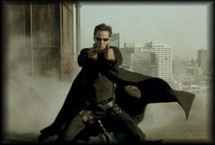
The brothers Andy and Larry Wachowski, who shared writing and direction duties, have created a fast-paced science fiction spectacular that's highly entertaining, at least for those who enjoy plenty of action, martial arts and gun play. It's a perfect movie for Reeves, who looks good, has reasonable charisma and isn't asked to utter particularly demanding lines. Fishburne and Moss are more than adequate as Neo's underworld accomplices.
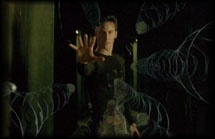
The Matrix is packed full of cutting-edge special effects and stunts, ranging from computer animation to an incredible scene with men dangling from a disabled helicopter as it wobbles amidst skyscrapers. In addition, there's at least one scene that's likely to challenge for your all-time personal Most Gunfire in One Sequence award.
What makes this a successful film is the fact that all the action is held together by moderately interesting relationships and a fascinating story of alternate versions of reality. While it's not everyone's kind of film, it is a strong example of its genre.
----------------------------------------------------------------------------------------------------------------------------------------
Bram Stoker´s Dracula
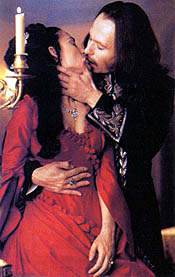
Back in the early nineties, director Francis Ford Coppola (The Godfather, Apocalypse Now) was attempting to pull himself out of a financial whirlpool by hitting a serious home run. He needed to prove he could still make films with wide appeal. Coppola brazenly (or maybe calculatingly) chose to re-make the much-filmed classic Dracula, tacking Bram Stoker's name to the title to skirt copyright difficulties.
The film begins with the story of Vlad the Impaler who left his home in Transylvania to fight in the Great Crusades only to find upon his return that his wife has taken her own life in the mistaken impression that he had been killed. Vlad's anger is so great that he denounces God and swears that he will live until his wife returns. It's a long wait. Four hundred years pass by until a young attorney (Reeves) shows up to arrange some real estate transactions in London. When Dracula spies a picture of the man's fiancée (Ryder) he knows that his beloved wife lives again and that he must travel to Victorian London to retrieve her.
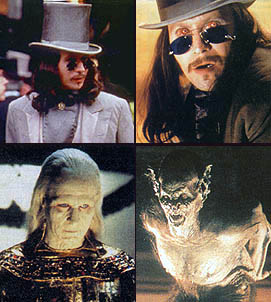
Coppola being the personality that he is, even while under financial duress, pulled out all the stops in what became a truly lavish production. It is operatic in scale, with costumes and sets that are truly stunning. The only point where Coppola obviously submitted to box office pressures was in casting Winona Ryder and Keanu Reeves as the young couple Dracula preys upon. While both are attractive in their own way, their acting often comes off as terribly wooden. Reeves attempt at an English accent is particularly painful. Coppola is redeemed and the film is greatly assisted by the presence of Brits Gary Oldman as the Count and Anthony Hopkins as Professor Abraham Van Helsing, a madcap vampire killer.
----------------------------------------------------------------------------------------------------------------------------------------
Blade
Blade was unexpectedly fun. When I first saw the previews I passed the movie off as some B-movie that just happened to get lucky and get a wide release. The previews do not do Blade justice.
The movie starts off with a quick sequence of how Blade (Wesley Snipes) came about. While pregnant with Blade, his mother was bitten by a vampire.
Because of this Blade is a half-vampire. He has the strength of a vampire while keeping some of the benefits of being human (being able to walk around in the daytime.) His weakness is that he still has the thirst for blood, but this can be cured by an injection of a special serum.
The movie Blade follows him as he tracks a mad vampire, Deacon Frost (Stephen Dorff). Frost wants to bring back the spirit of the all mighty and evil Blood God - a super-vampire. Blade and his side-kick, who is more like his equal, Whistler (Kris Kristofferson) are vampire slayers.
The story for Blade is not intricate, nor does it have great characterization. I think that director Stephen Norringon knew this from the start. Norrington counters the weak script by putting together a great looking film and putting in some adrenaline pumping action sequences.
First, the looks of Blade are incredible. It's a mix of Dark City, Batman, and The Crow. The film is dark, moody, and off-balance. Norrington and cinematographer Theo Van de Sande use some creative camera work to make the film visually stunning. People fly through the sky. When people land they do so with a ground-shaking energy. Things go from speedy to slow and then back to speedy. The film is a work of art. Norrington, Van de Sande, and editor Paul Rubell show that they know how to put together a film.
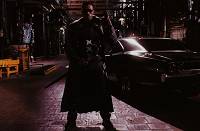
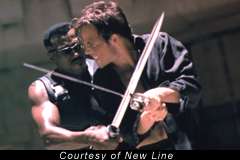
Unlike other films where quick editing and stylized shots may look cool but don't make sense (The Avengers), Blade is one that proves that in capable hands these technical elements of film making can actually make the film more enjoyable. Kudos to Norrington, Van de Sande, and Rubell.
Second, the action sequences are incredible! The introductory action sequence for the character Blade inside a dance club shows that director Norrington is no hack director. He handles this introductory sequence and the many others with a steady hand and good eye.
As for acting, everyone does OK. Snipes puts up a macho face and is hard to connect with in the film. He plays Blade as straight faced, but there are times Snipes makes it known that he is still half-human. Kris Kristofferson gives the best performance in the whole film. His Whistler has a mix of tough-guy and grandfather that is quite likeable. As for Dorff, he overplays his Frost, but in doing so he has made the villian of Blade much more memorable then if he hadn't.
One complaint about the film is that it is a bit gratuitous when it comes to blood and gore. OK, it is a vampire film, but some portions of the film are just awful and gross. There are scenes of people exploding, heads exploding, and people being burned. I found it just a bit more than I could handle at times. Blade is definitely not a film for younger teens.
Blade is a fun film. Catch it in the theatres if you have a chance; otherwise this would make for a good video rental.
----------------------------------------------------------------------------------------------------------------------------------------
Sleepless in Seattle
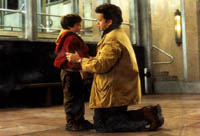
Sleepless In Seattle (Starring: Tom Hanks, Meg Ryan, Ross Malinger, Rosie O’Donnell, and Bill Pullman & Directed by Nora Ephron) allows the romantic to believe that love still heals the broken-heart, creates hope and fulfills dreams in an age of disillusionment and despair. Sleepless In Seattle embellishes this fundamental truth. It is a subtle reminder that no matter how desperate our situation may be and regardless how painful it becomes to us, love conquers all.
Having lost his wife to cancer, Sam Baldwin (Tom Hanks) moves from Chicago to Seattle in an attempt to escape the memories and start a new life. His 8-year old son, Jonah (Ross Malinger, Toothless) a restless and independent-minded child, phones a radio talk-show psychologist and asks for help. He explains in vivid detail the pain that his father endures; and when asked by the host to put his father on the phone, he compellingly does so. Sam awkwardly and somewhat reluctantly pours out his heart to the radio listeners. As he talks about his wife and the love they shared together, Annie Reed (Meg Ryan), a Baltimore journalist who happens to be engaged to Walter (Bill Pullman, Independence Day), listens and becomes enchanted by what she hears. She, along with thousands of other women, contact the station asking for Sam’s phone number. Many write letters expressing their admiration of him and some even proposing. Annie, enamored by this man, hires a detective to find out more about him. Eventually, she flies to Seattle in a feeble attempt to find him.
Meanwhile, Jonah reads Annie’s letter and becomes convinced that she is the one who can fill the void in his father’s life. He tries to find her, Sam tries to find Jonah and Annie tries to find Sam. And of course, in the end, they all find each other.
This delightful, romantic comedy has no hidden surprises. You know precisely what is going to happen. But who cares? Rent the video and buy a box of Kleenex, the women in the house will no doubt shed tears over this one. It is a good family film.
----------------------------------------------------------------------------------------------------------------------------------------
Mission to Mars
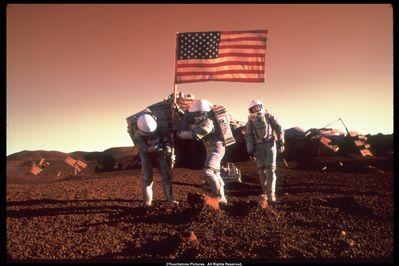
Brian De Palma's MISSION TO MARS is a mixture of great qualities: stunning visual/audio effects, a realistic portrayal of Mars and excellent research into space exploration. In terms of action and adventure, this movie is not to be missed. In terms of story, however, the plot falls short.
Throughout the film, we are voyaging... venturing... and heading towards Mars. Then, in the last twenty minutes, mind-shattering secrets about the origin of man are discovered. This is the best part--when the astronauts find something they had not expected. This is precisely what I wanted to find out more about, but before I could even marvel at the special effects, a huge THE END appears on the screen and everyone is getting up to leave.
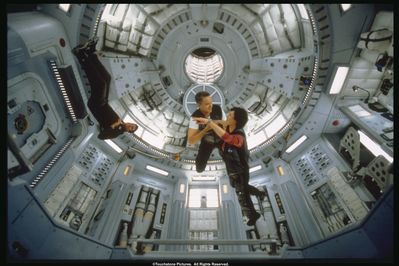
De Palma's efforts to steer the movie clear of cliché was well done, maybe too well done. For example, the musical score is extremely weird. During one tense scene where astronaut Woody Blake (Tim Robbins) is sealing a hole in the spacecraft (from outside), the music is unfittingly orchestral--violins are serenely playing as a crew member inside the spacecraft is experiencing acute asphyxiation from loss of atmosphere. It is like watching Jason from NIGHTMARE ON ELM STREET kill people while happy cartoon melodies play in the background. In addition, in his efforts to make the movie unique from APOLLO 13 (a much better movie, by the way) De Palma may have forgotten that Gary Sinise had a starring role as an astronaut in that as well.
Overall, the movie is worth seeing and best viewed in a theater. Visual effects are stunning and should not be restricted to the TV screen. Be prepared, however, to get motion sickness from some of the zero gravity scenes.
----------------------------------------------------------------------------------------------------------------------------------------
13th Warrior
It's the tenth century and Ahmed Ibn Fahdlan (Antonio Banderas) has committed the sort of indiscretion people in positions of comfort commit all to often. He fell for a woman he couldn't have. Worse, he fell for a woman whose husband has influence. As a result, the poet has been sent away from Baghdad to serve as an emissary to a far-off land. Before we know it, the mild mannered Ibn has met up with a group of Norse warriors and been drafted as one of 13 men who must travel north to rescue a threatened Norse king who is under attack by frightening enemies.
Much of the film is devoted to the inevitable conflict between the warriors and the Eaters of the Dead -- the exceedingly nasty guys who are tormenting the Norse king and what remains of his people. They arrive on horseback, sometimes carrying torches and always with an almost unbelievable viciousness. Their victims are mutilated, heads removed and carried off as souvenirs.
Will Ibn the cultured city boy adjust to life as a Norse warrior? Will they withstand the attacks? Will the rampage ever end?
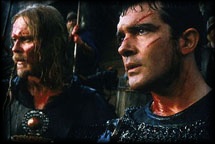
There's intense action and terrific violence for much of this film. It's well choreographed and filmed, but would still become dull if not for Banderas' skilled portrayal of Ibn. He is credible in the role, although it's difficult at first to think of the sturdy Banderas as "little brother", which is what the strapping Norsemen call Ibn. Banderas lets his face do much of his acting, and it works. We understand his fear, his pain and his anger. And, combined with the charismatic group of actors playing the warriors, we understand why Ibn is loyal to them, even if he was essentially kidnapped to join the group. Dennis Storhoi is particularly good as Herger the Joyous.
It's true that there isn't a whole lot to The 13th Warrior other than the carnage of the battle scenes. And it's true that we're given little insight into the characters and their motivations. But the film still succeeds. In addition to Banderas and the quality of the action sequences, the excellent costumes, sets and locations also contribute to the experience. This isn't a great film by any stretch, but it's exciting to watch and it works as long as you aren't expecting something other than what it is.
----------------------------------------------------------------------------------------------------------------------------------------
What Dreams May Come
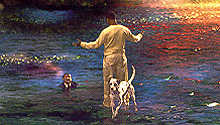
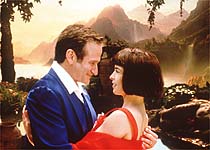
In short, Robin Williams and Annabella Sciorra play a story-book couple (initially at least) who endure some hardship (I won't give anything away in that regard). Things get worse when Robin Williams' character (Chris) dies unexpectedly. Chris finds himself in an after-life, a version of Heaven, where he's shown around by...someone (played by Cuba Gooding Jr.). Chris discovers, however, that his wife has committed suicide and won't be joining him in the great beyond. He decides, against Cuba's advice, to try to find her (in you-know-where) and bring her back with him.
I watched the bulk of this movie thinking that it would, in the end, rate a 2½ on my scale. I got to the final 15 minutes of the film, and, even though my mind wasn't yet "buying it," I had a giant lump in my throat.

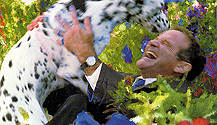
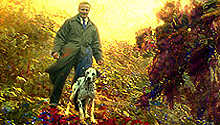
The multitextured visuals seem to have been created from a lost fairy tale. Heaven recalls the landscape paintings of Thomas Cole and Renaissance architecture complete with floating cherubs, while hell is a massive shipwreck, an upside-down cathedral overgrown with thorns and a sea of groaning faces popping out of the ground (one of those faces is German director Werner Herzog). Williams is the perfect actor to play against the imaginative computer-generated imagery--he himself is a human special effect.
The story's power begins to reveal itself by showing a great deal of interlocking devices. Scenes that seem odd on first exposure are later shown to be very important to the overall impact. As we head into the home-stretch (those final 15 minutes I mentioned above), everything starts falling into place, click, click, click. Holy smokes, it's not all pretty pictures and sweet music, but a bigger thing served by those elements. Then comes the lump in the throat, completely unexpected. And in the end, it all seems... if quite perfect, certainly profoundly touching. The film obviously is striving for that end, and it achieves it splendidly.
The acting is good all around, the special effects are beautiful
----------------------------------------------------------------------------------------------------------------------------------------
Austin Powers - International Man of Mystery
When I saw the trailer for Austin Powers: International Man Of Mystery a couple of months ago, it looked incredibly hilarious. I just had two annoying problems -- what if, as in so many awful movies, the only funny parts in the movie are the one in the trailer? And what if it turned out to be just one long, boring Saturday Night Live skit? Those fears were put to rest upon viewing Mike Myers’ new film. In the film, which spoofs all the James Bond movies of the 1960s and 70s, Myers plays two roles: Austin Powers and the Donald Pleasance / Blofeld lookalike, Dr Evil. Evil and Powers are cryogenically frozen for thirty years, and when Evil comes back to wreak havoc on the world, Austin is thawed out. He is given a female partner, played by the stunningly beautiful Elizabeth Hurley, and they set out to stop Dr Evil from destroying the world.
THE GOOD: -- The spoofs of all the plots of previous Bond films
-- The great names (Basil Exposition)
-- The psychedelic Laugh-In style interludes
-- The father-son subplot
-- The perfect placement of objects during “nude” scenes
-- The BBC song in the closing credits
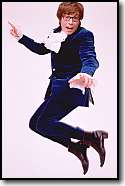

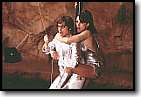
THE BAD: -- You have to have seen a few Bond films to get some of the jokes
-- Some gags last too long
-- Burt Bacharach
-- Michael York (Basil Exposition) looks like he has no idea why he’s in the film
All said and done, Austin Powers is a nice, nostalgic piece of fluff that is a welcome break from all the big-budget disaster flicks popping up this summer. I assume that many critics will bash the film because it doesn’t exactly make you think, but for pure fun it’s hard to beat Austin Powers. Teens will like the action and comedy, and adults will like that and the nostalgic feel to the film.
----------------------------------------------------------------------------------------------------------------------------------------
Austin Powers - The Spy Who Shagged Me
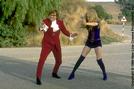
What do you say about a movie that's obsessed with women's breasts, bodily functions, and making fun of fat people and little people? A movie that's tacky and nerdish and proud of it? I suppose you just say, "Welcome back, Austin Powers!"
Two years after Mike Myers' surprise hit, Austin Powers: International Man of Mystery, Myers and company are back again. This time, Myers plays three roles: the good guy Austin Powers, the nasty archenemy Dr. Evil, and Evil's helper, Fat Bastard. Austin was a 1960s fashion photographer, babe magnet and super-spy who was put into the deep freeze in 1967, to emerge in the late 1990s. There he took on Dr. Evil and defeated him in the first movie. This time, Dr. Evil has returned, intent upon world domination. He has a plan to extort billions from the US government or blow up the world using a powerful laser (called the Allan Parsons Project) installed on the moon. To get Austin out of his way, Dr. Evil travels back in time to the '60s to steal Austin's 'mojo' (i.e. his libido) from the frozen super spy.
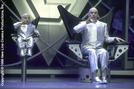
If you're getting the idea that this is silly movie, you're right. The whole point is to be silly, and this one definitely goes over the top time and time again. Austin is a total nerd who's a klutz with bad teeth, but woman flock to him. When Austin goes back in time to battle Dr. Evil, he teams up with Felicity Shagwell (Heather Graham). Felicity is a gorgeous American spy and she's pretty keen on Austin, even if he is missing his mojo. Will the pair succeed against Dr. Evil and his cronies? Is there any question? The fun is in watching how they pull it off.
Myers is fabulous in his many roles, including his unrecognisable turn as the corpulent Fat Bastard. Despite the multiple roles, he seems totally consumed in each of the parts. The supporting cast really has little to do other than overact appropriately, which they all do.
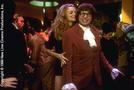
The Spy Who Shagged Me is packed with bad puns and sophomoric humour. Its portrayal of women is none too progressive. It depends on fat jokes, fart jokes, breast jokes and phallic humour as much as any recent film. It's also just too much campy fun and too well put together to dislike.
----------------------------------------------------------------------------------------------------------------------------------------
Galaxy QuestGalaxy Quest is a film directed by Dean Parisot, a director whose credentials include episodes of television’s ER and Northern Exposure. This experience proves both a benefit and a hindrance to this Star Trek spoof, a film which nicely dissects the cult of TV sci-fi dom, but flounders when it tries to stretch beyond into the realms of ‘meaningful’ cinema. If ever there were a minority worthy of parody and satire, it is the hordes of devoted fans committed to their favourite science fiction television show. Conventions and marketing have become a lucrative sideline to these shows, devoured by fantasy obsessed trainspotters intent on mastering the universe of the show. These cultists are such easy targets – they dress as their favourite characters, sprouting as fact the hollow, meaningless jargon passed off as truth by the show’s scriptwriters. Where Parisot’s film succeeds is in his efforts to both satirise this phenomenon, as well as recognise with some affection, the merits of such devotion. Sure, there are plenty of cheap shots at their expense (the scene at the convention’s urinal being one), but Parisot also delivers a modicum of grudging respect for their commitment and dedication to their chosen cause. It is a fine line Parisot walks between derision and admiration, but for the most part, Galaxy Quest succeeds in navigating this terrain with good humour and backhanded affection for the very people it derides.
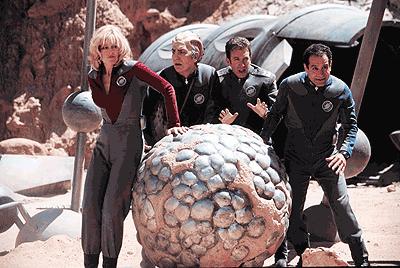
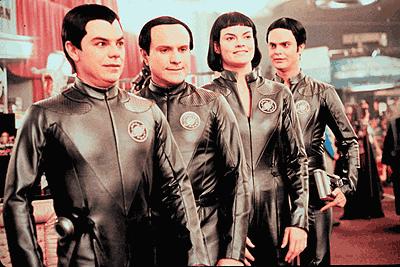
There’s no avoiding the Star Trek references to this film, and the opening sequence establishes both the irreverent tone of the film, and the characters who will carry us through the satire. The film is lead by Jason Nesmith (Tim Allen) who plays Commander Peter Quincy Taggart, a man who speaks in aphorisms and stands for all that is noble and good on ‘Galaxy Quest’, the television show. As the token female/Uhuru character, Gwen De Marco (Sigourney Weaver) plays Lt. Tawny Madison, whose primary function is to talk to computers and show her cleavage. The show’s substitute Spock is the level headed Dr. Lazarus (Alan Rickman, sporting what looks like half an octopus on his head), yet the actor who plays him, Alexander Dane is dissatisfied and scornful of his both his role and the cult of fiction that surrounds it. It is at one of these conventions for the show, that Nesmith is approached by four aliens from the planet Thermia, who, believing Nesmith and his show to be ‘historical documents’, appropriate him and his crew in their battle against the evil destructive army of the large green crustacean Sarris. Suddenly transported out of reality and into a truly ‘real’ fantasy, the humour stems from watching these actors desperately try to recreate the bravery and skill they exhibit on their show to save the gentle Thermians from the cruel fate that awaits them.
Whilst the film is probably broad enough to cater for the novice, a working knowledge of the genre leads to a far richer experience with this film – you’ll get more of the jokes. Sigourney Weaver (looking about twenty-eight in a blonde wig and push-up bra) gets the best lines, particularly her self-referential asides in relation to her work on the Alien films. Tim Allen is not an actor with any great
range, but in Galaxy Quest the demands of the role are all within his grasp, and he brings a gleeful exuberance to the film. Unlike his turn in Robin Hood, Rickman’s free range hamming is at least appropriate in this particular scenario (see him in Anthony Minghella’s Truly Madly Deeply for an insight into what he can do when he is restrained), but perhaps most impressive is the performance of Sam Rockwell. Rockwell, who was so absurdly over the top as Wild Bill Wharton in Frank Darabont’s The Green Mile lands the part of the nameless Guy, the extra who played Crewman #6 in one episode of the show. Guy functions in Galaxy Quest as Randy Meeks did in the Scream movies, essentially he serves to deconstruct the genre for the audience. Terrified that as the nameless ‘extra’ he is bound to be the first to die, he introduces a terrific and well-executed twist in the narrative. More than just a conduit to a parody of the stereotypes inherent in sci-fi, his character lifts the comedy to another level, one that exposes convention and expectation. In Rockwell’s hands, Guy becomes one of the most successful elements in the film.
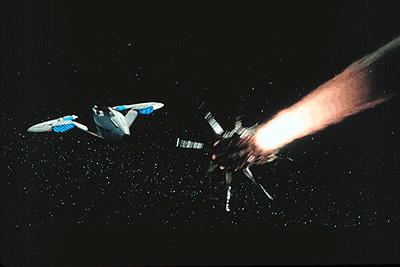
Parisot’s depiction of his aliens aims for laughs rather than authenticity – the Thermians are like intergalactic robots with identical haircuts and funny speech patterns. The evil Sarris (Robin Sachs) is basically just a mean looking oversized lobster who snarls and grimaces and even sports an eye patch apparently riveted to his skull (he looks like this and he’s worried about aesthetics?!). The script works effectively to keep the humans and aliens dropping lines and running down corridors at great speed, and the quality of the writing and the delivery ensures few jokes fall flat. Where Galaxy Quest maybe steps into less assured territory is in its moments of drama. It’s the sort of film that doesn’t benefit from any attempt to fit in depth or serious conflict. Parisot, though, seems to feel the urge, as if cinema must at least pay lip service to these qualities to be considered worthy. In this he is wrong, a film like Galaxy Quest needs to rely purely on the surface of things, the fun must be delivered on a platter, and that’s the pleasure of it. When the pace slows and people start looking pensive and concerned, the film wobbles and dives dangerously.
Galaxy Quest sets itself small aims and small goals, existing essentially within the parameters of the pulpish television shows it parodies – and it achieves them admirably. Its occasional forays into something grander tilt the film out of kilter and dislodge the comic equilibrium it has sustained so well. Galaxy Quest is best when it recognises its limitations and stays within them, letting the gags flow easily, without the forced restraints of a ‘message’. But these are minor hiccups. Galaxy Quest avoids the obvious crassness of something like Spaceballs and aims its barbs at both easy targets and more sophisticated prey. It is energetically performed, cleverly written and offers amusing digs at the cult of science fiction and the constructed realities of television. This is enough to ensure its success, without the need to go grandly overstepping its mark and reaching for the stars.
----------------------------------------------------------------------------------------------------------------------------------------
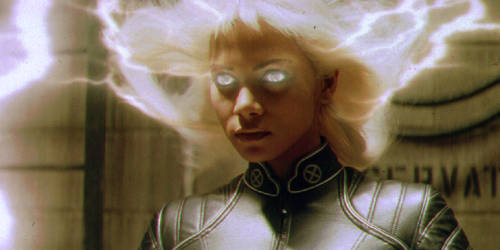
X-MenAre these mutants a different species from humans? Are they the next step in evolution? Should they be feared?. Professor Charles Xavier (Patrick Stewart has formed the X-Men, a team of these talented mutants. He has created a school for them, in part to shield them from a hateful world, and in part to train them in their supernatural abilities. The X-Men consist of Cyclops (James Marsden), who shoots energy bolts from his eyes, Jean Grey (Famke Janssen), who has telepathic and telekinetic abilities, and Storm (Halle Berry), who can control the weather. But what good is a superhero team without super-villains? Ian McKellan plays Xavier's nemesis, Magneto, a mutant who controls magnetism and metal. He has drafted others into a 'Brotherhood of Evil Mutants,’ including Mystique (Rebecca Romijn-Stamos) who can take any form but seems to prefer nearly nude and all blue, Sabretooth (Tyler Mane) who's feral strength makes him a force to be reckoned with, and Toad (Ray Park), a disgusting homunculus who shares many traits with his namesake.
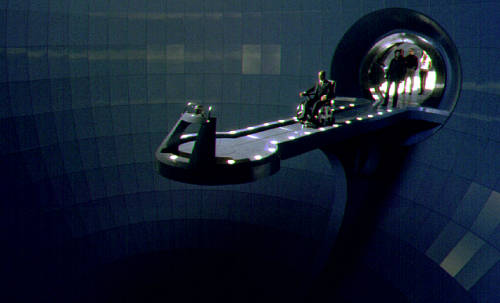
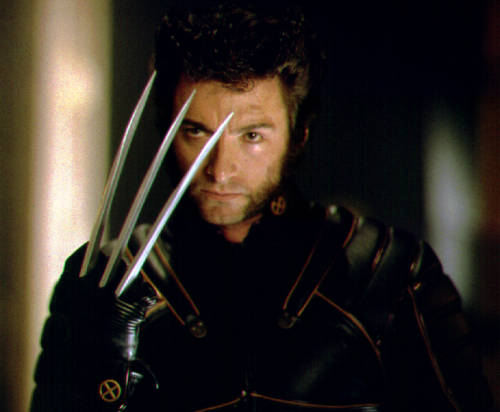
The story opens in a Polish Second World War concentration camp. Magneto, a Jewish boy torn from his parents, learns the cost of being different. We jump to the near future, where a young girl (Anna Paquin) is on the run. She too is a mutant with the ability to sap the life force from others – their memories, talents, everything. In a remote area, she runs into Wolverine (Hugh Jackman), a wild man able to instantly heal from any injury. The two don't realize that they're mutants, only that they're different from everyone else. The X-Men find them and take them in. Before long, the X-Men are pitted against the Brotherhood of Evil Mutants. Both sides are pawns in a battle of wills between Xavier and Magneto. Xavier believes that mutants and humans can live together; Magneto believes that mutants should take their rightful place in history, just as Homo Sapiens superseded Neanderthals.
X-Men is great fun. Comic book action heroes are often difficult to put into a real life context. In a gaudy, four-colour comic, they seem to fit in. Drop them on the silver screen and they look... silly. But here, Singer has deftly manufactured a world where these heroes can walk without looking like circus rejects. Long-time fans of the comic book might balk at the liberties taken with the character chronologies, but there are just as many scenes that have deftly been transferred from the realm of pen-and-ink. And those scenes look good. Stewart and McKellen play off of each other well, like players in a chess game, with the future of humanity hanging in the balance. Hugh Jackman, in the key role of Wolverine, is given centre stage through much of the movie and he really holds up his end. The energetic Ray Park is also a treat. Playing Darth Maul, he was the only jewel in last summer's spotty Star Wars: The Phantom Menace, and he leaps through X-Men with the greatest ease.
----------------------------------------------------------------------------------------------------------------------------------------
HEAT
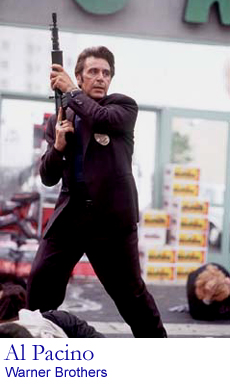
Having developed his skill as a master of contemporary crime drama, writer-director Michael Mann displayed every aspect of that mastery in this intelligent, character-driven thriller from 1995, which also marked the first onscreen pairing of Robert De Niro and Al Pacino. The two great actors had played father and son in the separate time periods of The Godfather, Part II, but this was the first film in which the pair appeared together, and although their only scene together is brief, it's the riveting fulcrum of this high-tech cops-and-robbers scenario.
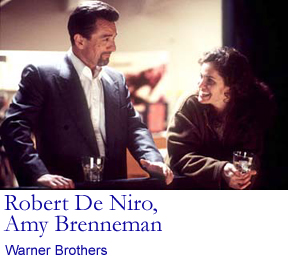
De Niro plays a master thief with highly skilled partners (Val Kilmer and Tom Sizemore) whose latest heist draws the attention of Pacino, playing a seasoned Los Angeles detective whose investigation reveals that cop and criminal lead similar lives. Both are so devoted to their professions that their personal lives are a disaster. Pacino's with a wife (Diane Venora) who cheats to avoid the reality of their desolate marriage; De Niro pays the price for a life with no outside connections; and Kilmer's wife (Ashley Judd) has all but given up hope that her husband will quit his criminal career. These are men obsessed, and as De Niro and Pacino know, they'll both do whatever's necessary to bring the other down.
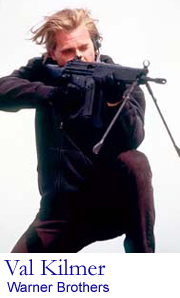
Mann's brilliant screenplay explores these personal obsessions and sacrifices with absorbing insight, and the tension mounts with some of the most riveting action sequences ever filmed--most notably a daylight siege that turns downtown Los Angeles into a virtual war zone of automatic gunfire. At nearly three hours, heat qualifies as a kind of intimate epic, certain to leave some viewers impatiently waiting for more action, but it's all part of Mann's compelling strategy. Heat is a true rarity: a crime thriller with equal measures of intense excitement and dramatic depth, giving De Niro and Pacino a prime showcase for their finely matched talents.
----------------------------------------------------------------------------------------------------------------------------------------
The Blair Witch Project
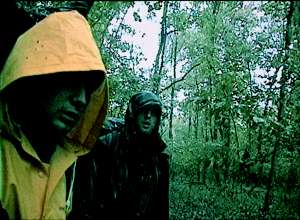
Anyone who has even the slightest trouble with insomnia after seeing a horror movie should stay away from The Blair Witch Project--this film will creep under your skin and stay there for days. Credit for the effectiveness of this mock documentary goes to filmmakers Daniel Myrick and Eduardo Sanchez, who armed three actors (Heather Donahue, Michael Williams, and Josh Leonard) with video equipment, camping supplies, and rough plot outlines. They then let the trio loose into the Maryland woods to improvise and shoot the entire film themselves as the filmmakers attempted to scare the crap out of them. Gimmicky, yes, but it worked--to the wildly successful tune of $130 million at the US box office upon its initial release (the budget was a mere $40,000). For those of you who were under a rock when it first hit the cinemas,
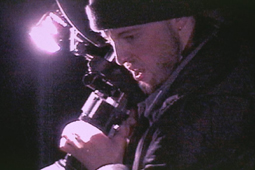
The Blair Witch Project tracks the doomed quest of three film students shooting a documentary on the legend of the Blair Witch from Burkittsville, Maryland. After filming some local yokels (and providing only scant background on the witch herself), the three, led by Heather (something of a witch herself), head into the woods for some on-location shooting. They're never seen again. What we see is a reconstruction of their "found" footage, edited to make a barely coherent narrative. After losing their way in the forest, whining soon gives way to real terror as the three find themselves stalked by unknown forces that leave piles of rocks outside their campsite and stick-figure art projects in the woods. (As Michael succinctly puts it, "No redneck is this clever!") The masterstroke of the film is that you never actually see what's menacing them; everything is implied, and there's no terror worse than that of the unknown. If you can wade through the tedious arguing--and the shaky, motion-sickness-inducing camerawork--you'll be rewarded with an oppressively sinister atmosphere and one of the most frightening denouements in horror-film history. Even after you take away the monstrous hype, The Blair Witch Project remains a genuine, effective original.
----------------------------------------------------------------------------------------------------------------------------------------
Charlie´s Angels
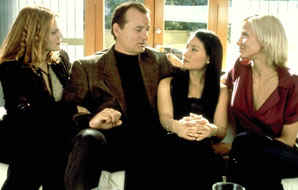
Happily Charlie's Angels is a surprisingly successful TV-into-movie update of the seminal 1970s jiggle show. Cameron Diaz, Drew Barrymore (who also produced) and Lucy Liu star as the hair-tossing, fashion-setting, kung-fu fighting trio employed by the mysterious Charlie (voiced by the original Charlie, John Forsythe). When a high-tech programmer (Sam Rockwell) is kidnapped, the angels seek out the suspects, with the daffy Bosley (Bill Murray in a casting coup) in tow. A happy, cornball popcorn flick, Charlie's Angels is played for laughs with plenty of ribbing references to the old TV show as well as modern caper films like Mission: Impossible. McG, a music video director making his feature film debut (usually a death warrant for a movie's integrity), infuses the film with plenty of Matrix-style combat pyrotechnics, and the result is the first successful all-American Hong Kong-style action flick.
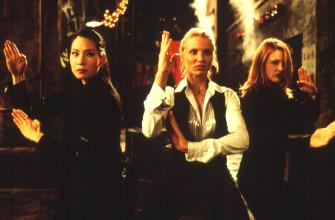
Plenty of movies boast a New Age feminism that has their stars touting their sexuality while being their own women, but unlike something as obnoxious as Coyote Ugly, Angels succeeds with a positive spin on Girl Power for the new millennium (Diaz especially sizzles in her role of crack super agent/airhead blonde). From the send-up of the TV show's credit sequence to the outtakes over the end credits, Charlie's Angels is a delight.